Monday, July 12, 2010

Changing Fuel: Josh Tickell's Biodiesel Mission

This is #22 in a series of blog posts about recovering from the Gulf oil spill and from oil dependency overall. The first introduces the series.

Yesterday I wrote here about ways we can cut crude oil consumption as we eat. If you read that post, you might have noticed that diesel fuel supplies a lot of the petroleum energy we use to produce and ship food.

In fact, according to a report from the Congressional Research Service, 27% of energy for agricultural production comes from diesel. Additional diesel is used as we ship food items an average of 1500 miles from farm to table.
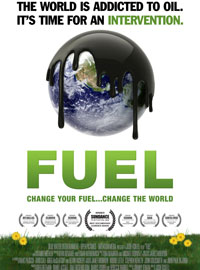
Josh Tickell, director of the award-winning documentary Fuel, wants this – and all the other ways we use diesel – to shift. With the slogan "Change Your Fuel, Change Your World," he advocates using biodiesel instead of the petroleum form, and has dedicated his (not yet very long) life to fomenting that switch.

I first wrote about Josh Tickell (he pronounces it Tih-KELL) in Divorce Your Car! when he was touring the U.S. in the Veggie Van. A Winnebago with a two-liter diesel engine, the brightly painted Veggie Van needed no alterations to run on pure biodiesel. The van towed a Green Grease Machine used to strain food matter out of used vegetable oil obtained from fast food restaurants, and then "crack" the oil molecules into smaller units for easier burning.


Fuel, which recently came out on DVD, has some great scenes of the Veggie Van on tour, especially as Tickell pulls into fast-food drive-thrus to ask for all their used frying oil. Later, the film visits Carl's Corner truck stop in Texas, one of many stations in the U.S. selling biodiesel, to interview truckers as they fill up on the light gold fuel. It also includes footage on the move to switch school buses to biodiesel, in part because diesel fumes can accumulate and concentrate inside buses. Children are particularly vulnerable to suffering respiratory problems – including lung damage – from petroleum diesel pollutants; for air quality, biodiesel is a big improvement, reducing emissions up to 75%, depending on the blend (generally ranging from 100% plant-derived biodiesel to a mix of 20% plant diesel with 80% petroleum diesel). To the extent that it cuts consumption of crude oil, biodiesel also reduces the risk of severe environmental impacts that go along with every stage of extracting, refining, and burning petroleum products.

If you follow biofuels news, you might be stopping here and saying, "Wait – what about the studies that determined biofuels are actually WORSE for the environment than oil?" Fuel covers that as well, recounting the political and economic fallout from the finding that biofuel production could generate more greenhouse gases than conventional fuels due to the clearing of natural land to grow biofuel source crops. About the same time, food riots and price hikes occurred because some biofuels production had already begun to displace food crops. With government support withdrawn, the biofuels market suffered.

This also sent Tickell back to the biodiesel drawing board, then out to find ways that biodiesel might be made without affecting the food supply or resulting in net increases in greenhouse gas emissions. Fuel shows how he finds these, following him to interviews with researchers and entrepreneurs making biodiesel from algae, or from waste products. As with many things, we see that how sustainable biodiesel might be, and how much it might help us recover from oil addiction, depends on how we make and use it, and how much.

As he advocates biodiesel, Tickell acknowledges it can't do the whole job of getting us off oil. To his credit, he also talks about the need for energy efficiency. This echoes my own perspective that widespread conversion to any different fuel is not a panacea. We can benefit from powering motor vehicles as cleanly as possible, but we also – and especially – need to reduce how much we use them.

Tickell made this movie well before the Deepwater Horizon rig exploded in the Gulf of Mexico. It was particularly compelling, then, to see all the scenes this film shows of the oil industry in Louisiana. It turns out Tickell's mother comes from that state (his father's from Australia) and we see in the film how he was shaped by spending part of his childhood there. Well before the current Gulf disaster, Fuel tells us, oil drilling and refining had turned parts of Louisiana into a Cancer Alley; in Fuel, Tickell hints that some of his family members sickened and died for this reason.

Watching this film now, as millions more gallons of oil gush into the Gulf, decimating fisheries, fouling the air, and sickening people exposed, only lends more urgency to Tickell's message. Fuel is the story of one man's search for a way out of oil addiction. Others among us might find different routes, but it's the kind of journey we all need to follow.

Sunday, July 11, 2010

Eating Fewer Fossil Fuels

This is #21 in a series of blog posts about recovering from the Gulf oil spill and from oil dependency overall. The first introduces the series.

I know. You’re probably thinking, “I don’t EAT fossil fuels!” In essence, though, you do – we all do – because our current food system relies so heavily on inputs of petroleum and natural gas at every stage.

Most fields are plowed and planted using petroleum diesel. Commercial farms use fertilizers manufactured from natural gas feedstocks, and pesticides derived from petroleum. Harvesting by machine consumes additional diesel. Processing and packaging require energy and petrochemical plastic while distribution consumes yet more diesel as well as gasoline.

A 1994 study led by David Pimentel of Cornell University examined these issues and calculated that feeding each American consumes about 400 gallons of oil equivalents per year. Based on that figure, each of us consumes a little over a gallon of oil per day when we eat – and as we do this, we feed the demand for oil that leads to risky deepwater drilling and the degradation of ecosystems like the Gulf of Mexico.

Eating less petroleum is thus another important part of recovery from oil dependence. Fortunately there are several delicious ways to cut back on consuming crude when we eat.

1) Eat organic. About 2/3 of petroleum-derived pesticides used in the U.S. are used by agriculture, says a background report from the Congressional Research Service. You can avoid that by eating certified organic foods – which are better for you, anyway, based on recent research. A study from University of California at Davis, for instance, found that strawberries grown without pesticides contain more antioxidants – good news for all my friends who’ve been picking organic strawberries this season here in Upper Michigan.

2) Avoid processed and plastic-packaged foods. Processing and packaging consume fossil energy as well as adding petroleum-derived plastic to the food chain. Packaging food in plastic not only increases our use of oil, it can add undesirable chemicals to the food itself. As noted in this fact sheet from Berkeley, California’s Ecology Center, compounds in plastic wrappings can migrate into food; eating that food can expose you to hormone disrupters and possible carcinogens.

3) Skip the factory-farmed meats. As Michael Pollan has written in The Omnivore’s Dilemma, it takes nearly a barrel of oil to grow just one factory-farmed steer to slaughter weight. All the hormone and antibiotic residues in factory-farmed meat are another good reason to avoid it. Even though I don’t have numbers I suspect the equation changes for locally raised, organic, grass-fed meat and hunted game, neither of which are likely to consume as much petroleum as factory farming. Author and organic grower Eliot Coleman, for instance, has argued that more fossil fuel is used and CO2 generated by “a vegetarian eating tofu made in a factory from soybeans grown in Brazil” than by local production of a grass-fed steer. I’m not advocating for or against vegetarianism here, just saying that the decision of whether to eat meat at all is complicated. However, whether to eat factory-farmed meats is much more black and white, as the evidence against factory farming is so compelling.

This Farmer's Market stall features organic produce.

4) Eat more locally. Like the meat issue, this can also get complicated. Writer Sarah DeWeerdt pointed out in a recent World Watch Magazine article that how much local eating cuts energy consumption can vary. Still, the petroleum we use to transport food is significant. Paying attention to where food comes from can help reduce the average 1500 miles that standard grocery items travel as they’re trucked from farm to table. Check labels in grocery stores to see where foods are from; get to know growers in your area and buy direct from them; attend farmer’s markets and buy from growers there. Farmer’s markets, often lively and beautiful events, have the added benefit of featuring many certified organic growers.

5) Grow your own. There’s nothing more local, tasty, and petroleum-free than fresh-picked organically-grown produce from your own garden. The garden photos in this post come from ours, which provides us with wonderful salads and vegetables. The kind of garden space we have is nice, but not required; even apartment dwellers can grow some of their own food by gardening in containers. And just about anyone can grow sprouts, a wonderful source of fresh, raw nutrition. It’s a favorite approach to food growing for my friend Jill Nussinow, The Veggie Queen, who gives these instructions for sprouting on her blog, along with her recipe for Rainbow Sprout Salad.

Our passive solar greenhouse helps us grow our own greens, like these collards and kale, during long winters.

There’s plenty more interesting reading about making our food more sustainable and less petroleum-based all over the web; one I like is the Locavores site, locavore being a coined word referring to one who eats from within a specified local area. One tragedy we are witnessing now is how drilling for oil has made the accessing of local foods – mainly fisheries – difficult, unhealthy and/or impossible for a big segment of the Gulf coast population. This lost access to local food is a big part of what shocked Gulf residents now lament. Like oil and water, oil and sustainable food don’t mix, and I’m hoping we will fully understand that before it’s too late.

Saturday, July 10, 2010

Images of a Less Oil-Dependent World

This is #20 in a series of blog posts about recovering from the Gulf oil spill and from oil dependency overall. The first introduces the series.

Surrounded as we are by highways, cars, motorboats, jet planes and video feeds of yet more crude oil gushing into the Gulf of Mexico, it can be hard to imagine a modern world free from dependence on petroleum. Still, visualizing our recovery from oil addiction is an important part of achieving it, and good photography can help.

The world already contains counterpoints to oil dependence: ingenious uses of human power, like the cargo bikes in this post of mine and this one from Alan Durning; less costly and more efficient systems of mobility, like the carsharing I wrote about yesterday; places and events where pedestrians and cyclists take precedence over cars, like the street conversion organized recently by the World Carfree Network to top off its Towards Carfree Cities Conference in York, England. Good photography can remind us that such things exist, and can help us visualize more of them.

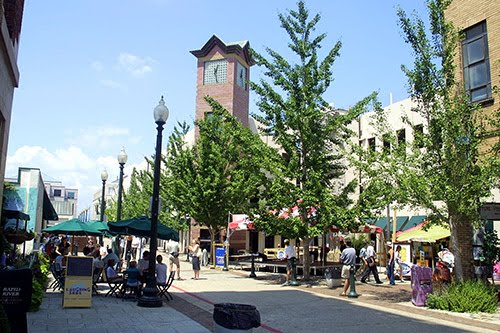
Enjoying the day on a pedestrian boulevard in Asheville, North Carolina.
Photo credit:
www.pedbikeimages.org /Dan Burden

One very nice source of reduced-petroleum pictures is the Image Library of the Pedestrian and Bicycling Information Center (PBIC). The images in today's post, downloaded from that site, illustrate pedestrian boulevards and fit my perception of what a world recovered from oil dependence could look like. It's encouraging to see these pictures and know that there are, in fact, places in the world – and even in the U.S. – where people can live, work and socialize without cars and without using so much oil.

A street for people in Utrecht, Holland.
Photo credit: www.pedbikeimages.org / Ryan Snyder

The PBIC Image Library includes a wealth of shots by several good photographers – one being Dan Burden, a former National Geographic photographer who now consults around the world to help make communities more livable and walkable. PBIC's photo collection features views of all kinds of bicycle and pedestrian facilities, as well as pictures of transit and other urban design features. The images are free to download for non-commercial use; the service asks users to include photo credits.

It's a great source of inspiration for visualizing our recovery from petroleum dependence, and for achieving an oil-free future.


Friday, July 09, 2010

Carsharing to Cut Oil Dependence

This is #19 in a series of blog posts about recovering from the Gulf oil spill and from oil dependency overall. The first introduces the series.

Today I applied to join Zipcar.

I've wanted to join a carsharing service for some time, but one thing has held me up: carsharing has not yet expanded into my area. However, Zipcar – currently the largest carsharing service in the world, and in the U.S. – has now grown enough that it's worthwhile for me to join and use when I travel. This morning I signed up for their "Occasional" plan.

Why do this? I travel car-free as much as I can, but for some trips, driving is the most practical option. In those cases I choose to rent cars, and try to get hybrids when I can. Sometimes, though, I only want a car for less than the full day most rental companies use as a minimum. That's when carsharing, which allows members to reserve cars by the hour, becomes a very useful option.

I'm also joining because I'd like to see the practice of carsharing grow. Studies show that more carsharing means fewer cars; the Zipcar website estimates that every carshare vehicle takes 15 to 20 personally-owned vehicles off the road. Not only does carsharing cut the number of vehicles, it also reduces miles of driving. Because carsharing is priced differently than car ownership, with members paying for their actual use of a vehicle and not for all the costs associated with having one sit in the garage, carsharing users drive more judiciously than car owners. In a retrospective study, Susan Shaheen and co-authors from University of California, Berkeley's Transportation Sustainability Research Center report that carsharing cuts vehicle miles traveled by about 44% on average. It also leads to greater use of transit, cycling and walking as well as reduced parking demand. That all adds up to significant reductions in oil and gas consumption.

A Zipcar sits waiting for use in its reserved parking space. Most carsharing services offer a variety of vehicle types for use by members.

Another big reason carsharing now enjoys sizable growth, and maybe the biggest: it saves people money. Zipcar estimates its members can save around $500 per month if they use carsharing instead of owning a car. Susan Shaheen et al found that carsharing members save $154 to $435 per month, a more conservative range but still substantial.

I like the way carsharing works. With Zipcar, once you join, you can reserve a car by the hour or by the day anywhere in the system. Reservations can be made by phone or online. A smartcard gives you access to the nearest car, parked in some central location in the area served. The company pays for the gas: your rates cover fuel costs, insurance, roadside assistance, and mileage.

A Zipcar member accesses a reserved car by waving a smartcard over a card reader inside the car's windshield.

Many members use carsharing in place of a second car, and some use it in place of owning any car at all. This second option works well for those who live in urban areas served by good transit, where car ownership is often a costly hassle.

When Divorce Your Car! came out ten years ago, carsharing had reached a healthy adolescence in Europe and the pre-teen stage in Canada, but was in early infancy in the United States. Today, the field is maturing, with 27 different carsharing programs in about 50 U.S. cities, nearly 7,600 vehicles and approaching half a million members. Besides Zipcar, a number of smaller carsharing services exist in the U.S., some for profit, some non-profit. You can check the CarSharing.Net website for a list of services and locations, with links.

I see carsharing as part of a new approach that can help us recover from oil dependence. Carsharing services tend to share that goal, thus using a high percentage of fuel-efficient or hybrid vehicles in their fleets. The Zipcar website lists a plug-in hybrid getting over 100 mpg as one of its San Francisco cars. A short distance to the north, in Sebastopol, California, SolarCarShare – a project of the Post-Carbon Institute – is about to launch with a small fleet consisting entirely of electric vehicles and hybrids. The service has installed electric charging stations around town with the intention of using renewables – solar and wind – to power them.

CityCarShare vehicles - a disabled-accessible van and two hybrids -- sit waiting for users in Berkeley, California, where the carsharing service shares vehicles with the city government -- see below.


I'm hoping it's only a matter of time before carsharing opens near me. Right now, the biggest growth market for carsharing is on college campuses, and I live not far from two universities. Zipcar currently has plans to expand, and as they do, I hope they'll look this way.

By the way, to sign up for Zipcar, cover the $25 application fee and pay $50 for a year's membership, I used my Amtrak Guest Rewards credit card, which sends Amtrak a cut of my purchases and nets me points to redeem for train travel in exchange. Instead of swiping my credit card at a gas pump, it feels good to have voted with my dollars for a different kind of transportation. It's one that gives me travel options without requiring car ownership; it has the potential to save me money; and -- hardly least on the list -- it uses a lot less oil.

Thanks to the Zipcar managers from Portland, Oregon, who originally supplied me with the top three images above for a presentation about reducing dependence on automobiles.

Thursday, July 08, 2010

The Toxicity of Oil

This is the eighteenth in a series of posts about recovering from the Gulf oil disaster and from oil dependency overall. The first introduces the series.

In the last couple of months, Gulf-area poison control centers have received 651 "exposure calls" related to crude oil toxicants. Symptoms reported by callers have included headaches, nausea, vomiting, diarrhea, throat irritation, eye pain, coughing or choking and dizziness. According to the Gulf Oil Spill page of the American Association of Poison Control Centers, most exposures have occurred via inhalation, with dermal contact also reported.

You can see some graphic documentation of crude oil’s effect on skin in a photo of some rash-afflicted legs posted yesterday with commentary by Riki Ott on the Huffington Post.

I viewed the rashy-legs picture after finishing yesterday's write-ups on the toxic petroleum byproducts contained in perfume, one on this blog and the other at the North Coast Holistics blog. At the same time, I discovered a fabulous piece by Stacy Malkan – ironically, or maybe not so, with the same title I had just given one of mine, "Petroleum in Perfume" – which eloquently relates toxic petrochemicals in fragrances to the Gulf spill disaster. It's a must-read, emphasizing the need to move away from past toxic practices and adopt new, greener approaches in all spheres of industry and life. Let's rethink petrochemicals, Malkan writes, and "move the entire economy toward renewable energy, clean production and green, safe chemistry."

As author of Not Just a Pretty Face:The Ugly Side of the Beauty Industry and cofounder of the Campaign for Safe Cosmetics, Malkan advocates that approach on a regular basis. The Campaign calls for elimination of toxic ingredients -- chemicals linked to birth defects, cancer, and other health issues -- in body care products. A recent analysis by the Campaign shows that top-selling perfumes contain hazardous compounds and secret petrochemicals.

That's not unlike the dispersant Corexit 9500 now being used to "clean up" in the Gulf. A few weeks ago, an article by Elana Schor in the New York Times (originally from Greenwire) reported that Nalco, producer of Corexit, had issued press releases noting that the dispersant's ingredients also occur in several common household products. Apparently fashioned to reassure the public, the release I found at Nalco's website noted that various unnamed ingredients in Corexit are also used in beverage mixtures, skin cream, body shampoo, and baby bath liquid.

This was not reassuring to me -- in fact, it had the opposite effect. It’s another indicator that the use of potentially harmful petrochemicals in common products has been undisclosed and unregulated for far too long. It's also another good reason to support the goals of the Campaign for Safe Cosmetics, as well as all campaigns working to reduce our use of oil.

To tie this back to transportation, we also get plenty of personal exposure to toxic petroleum byproducts from cars. We're exposed at gas stations, in garages, and from tailpipe exhaust. Studies have consistently found higher cancer rates among people living closer to busy roads, where exhaust reaches highest concentrations. Inside cars, exposures might be even worse. Some studies have found pollution levels within cars to be higher than outside them. In addition, "new car smell" is loaded with endocrine disrupters, compounds that off-gas from petrochemical auto interiors, get into our bodies, and mess with hormone function.

We have some big reasons compelling us to end our dependence on oil, with the Gulf disaster, climate change, and the huge military cost of procuring oil all on the list. Petroleum toxicity is one more, and with the ever-increasing incidence of cancers and chronic illnesses linked to petrochemical exposures, it is no less important.